
The Offshore Era Is Not Over But Nearshore Is Winning in 2026
For decades, offshore outsourcing was the default choice for US businesses looking to reduce IT development costs. Send the work overseas, save on labor, ship the product.
That calculation is changing fast.
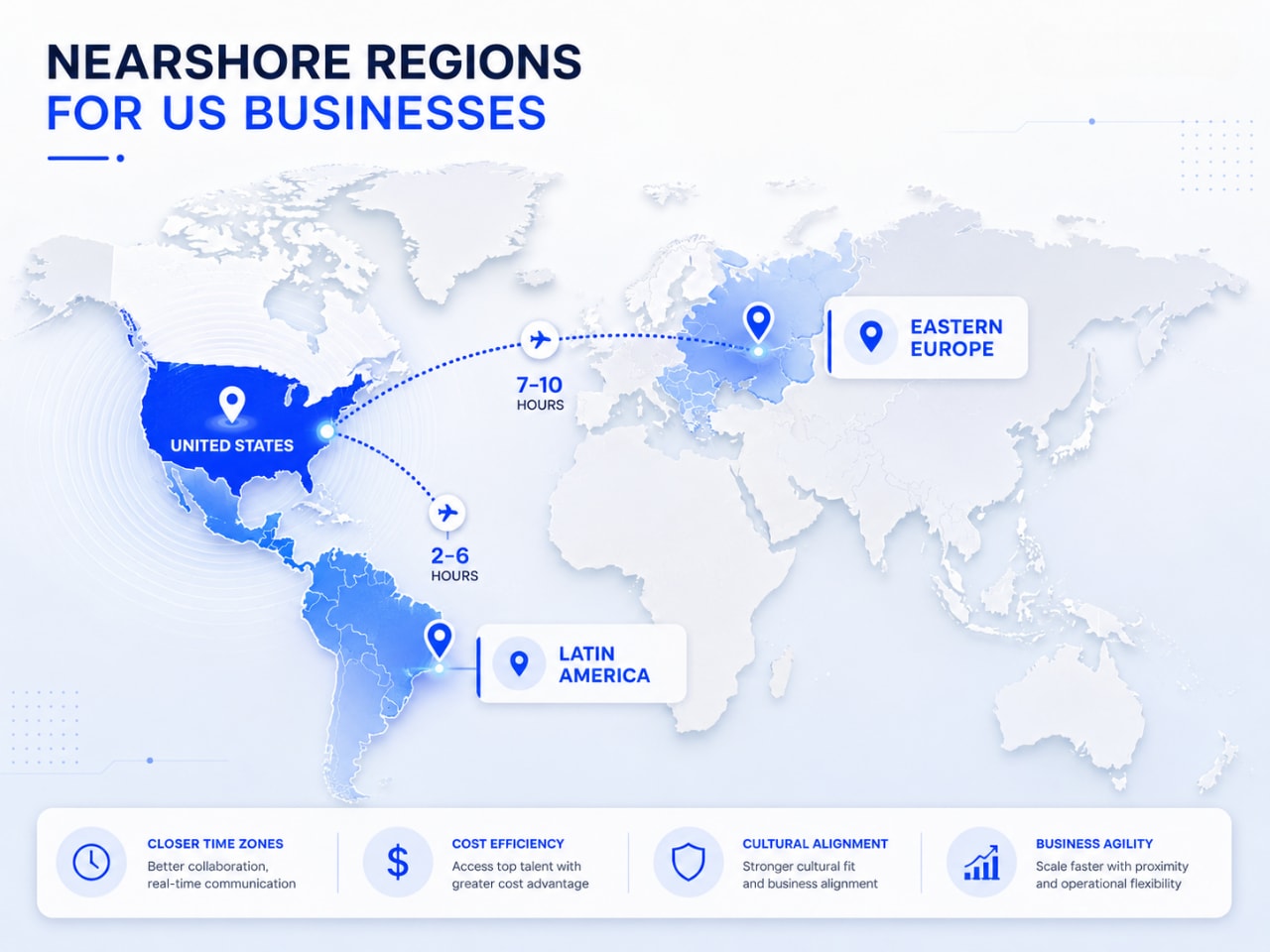
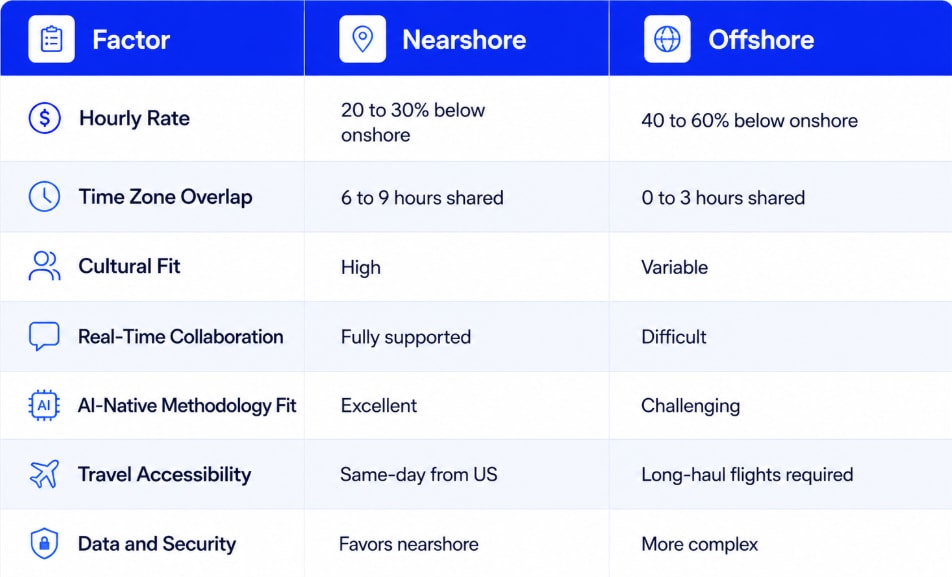
About 64% of US companies now favor nearshore partners over traditional offshore models for time-sensitive projects. Nearshore providers in Latin America and Eastern Europe offer costs 20 to 30 percent below onshore rates while sharing time zones and often similar cultural approaches to business.
In 2026 the decision between nearshore and offshore is no longer just about hourly rates. It is about collaboration quality, AI-native delivery, and how fast your development partner can actually respond when something goes wrong.
Choosing the right software outsourcing model is now one of the most strategically important decisions a US business makes before a single line of code is written.
Nearshore vs Offshore: What Has Actually Changed in 2026
For most of the last decade the nearshore vs offshore decision came down to a familiar set of tradeoffs: lower hourly rate versus easier collaboration, time-zone overlap versus deeper savings, cultural compatibility versus raw cost arbitrage. Those tradeoffs are all still real. But in 2026 there is a third axis that has reset the math: methodology. A nearshore partner running an AI-native methodology now delivers materially more per engineer than a traditional nearshore team and far more than a comparable offshore team.
What this means in practice:
- Nearshore teams in Latin America share 6 to 9 hours of working day overlap with US businesses
- Offshore teams in Asia-Pacific share 0 to 3 hours of overlap requiring async-first workflows
- AI-native methodology needs fast Plan and Confirm cycles which need real-time collaboration which needs shared business hours — nearshore has those conditions built in
- Cultural alignment reduces friction in daily communication, sprint ceremonies, and escalation processes
- Same-day travel from most US cities to Latin America hubs is realistic when in-person collaboration is needed
The Real Cost Comparison in 2026
Offshore still wins on raw hourly rate. Nearshore wins on almost everything else that determines whether a project succeeds.
Why US Businesses Are Making the Switch
The growing preference for nearshore and hybrid delivery models over purely offshore outsourcing is being driven by the need for greater collaboration, time-zone alignment, cultural compatibility, and faster response times particularly for complex mission-critical IT services. As outsourcing expands into cloud engineering, cybersecurity, DevOps, software development, and AI implementation, enterprises require closer integration between internal teams and external providers.
The top reasons US businesses are choosing nearshore in 2026:
- Daily standups, sprint reviews, and real-time problem-solving happen during shared business hours
- Escalations get resolved the same day instead of waiting for the next morning
- AI-augmented development requires tight feedback loops that async offshore workflows cannot support
- Cultural alignment means fewer misunderstandings in requirements and fewer costly revisions
- Legal and compliance frameworks in Latin America are increasingly aligned with US standards
Where Offshore Still Makes Sense
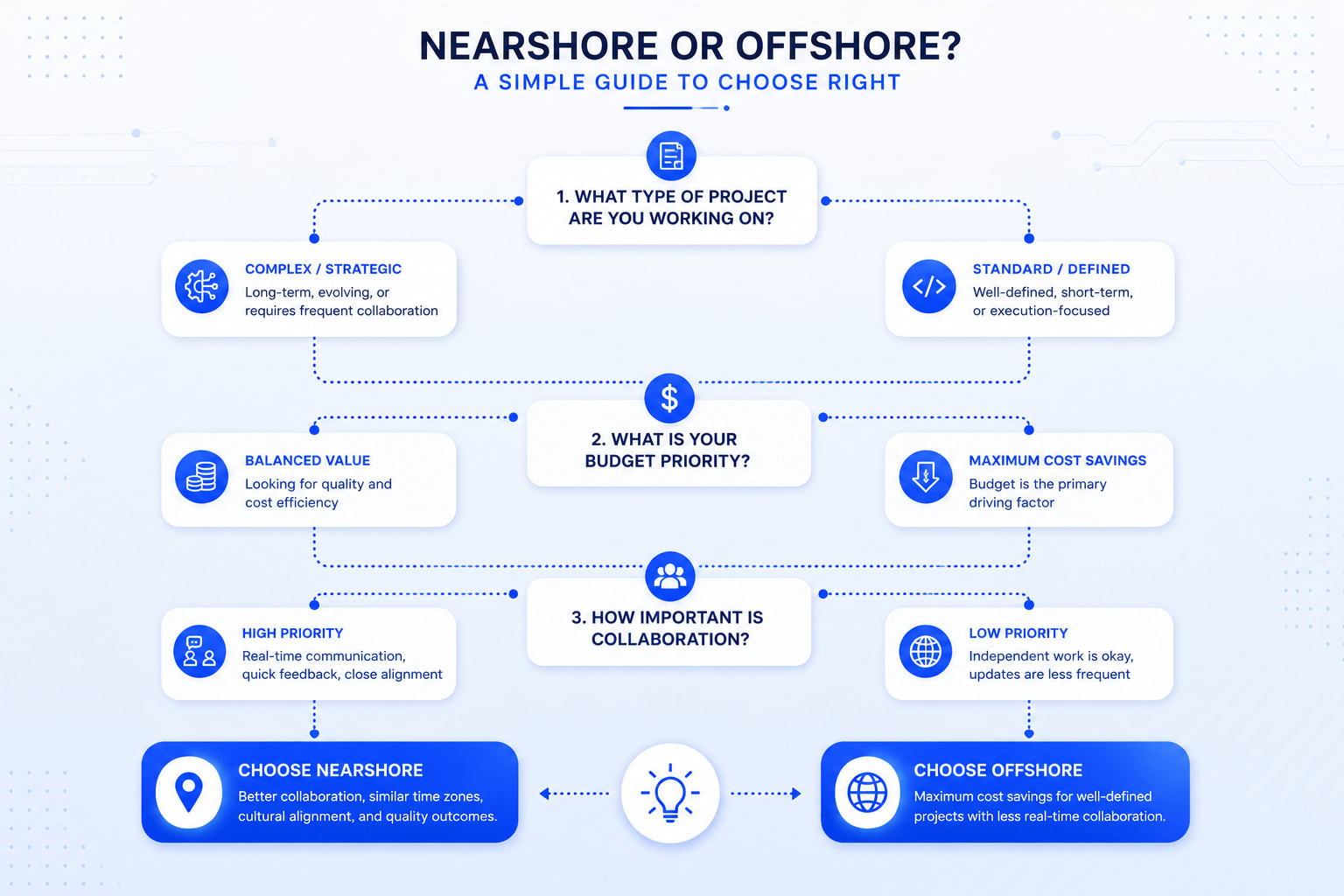
Nearshore is not the right answer for every situation. Offshore remains the better choice when:
- The project is large-scale, well-defined, and requires maximum headcount at minimum cost
- The workload is non-time-sensitive such as QA automation, data processing, or L1 support
- Async-first workflows are already embedded in how the internal team operates
- Budget constraints make the hourly rate difference a non-negotiable priority
If your evaluation criterion is hourly rate alone, offshore wins. Some offshore engagements deliver real cost savings if the workload tolerates async-first collaboration.
What to Look for in a Nearshore IT Outsourcing Partner
Not every nearshore partner delivers on the proximity advantage. When evaluating a dedicated nearshore development team look for:
- Confirmed time zone overlap of at least 6 hours with your US team
- Agile delivery with daily standups and sprint ceremonies during shared business hours
- Senior developers with AI tools embedded in their daily workflow
- Clear communication process with a dedicated project manager as single point of contact
- Track record of delivering complex projects for US clients specifically
- Transparent contracts covering IP ownership, confidentiality, and data security